News and reviews of Rock n Roll Soccer


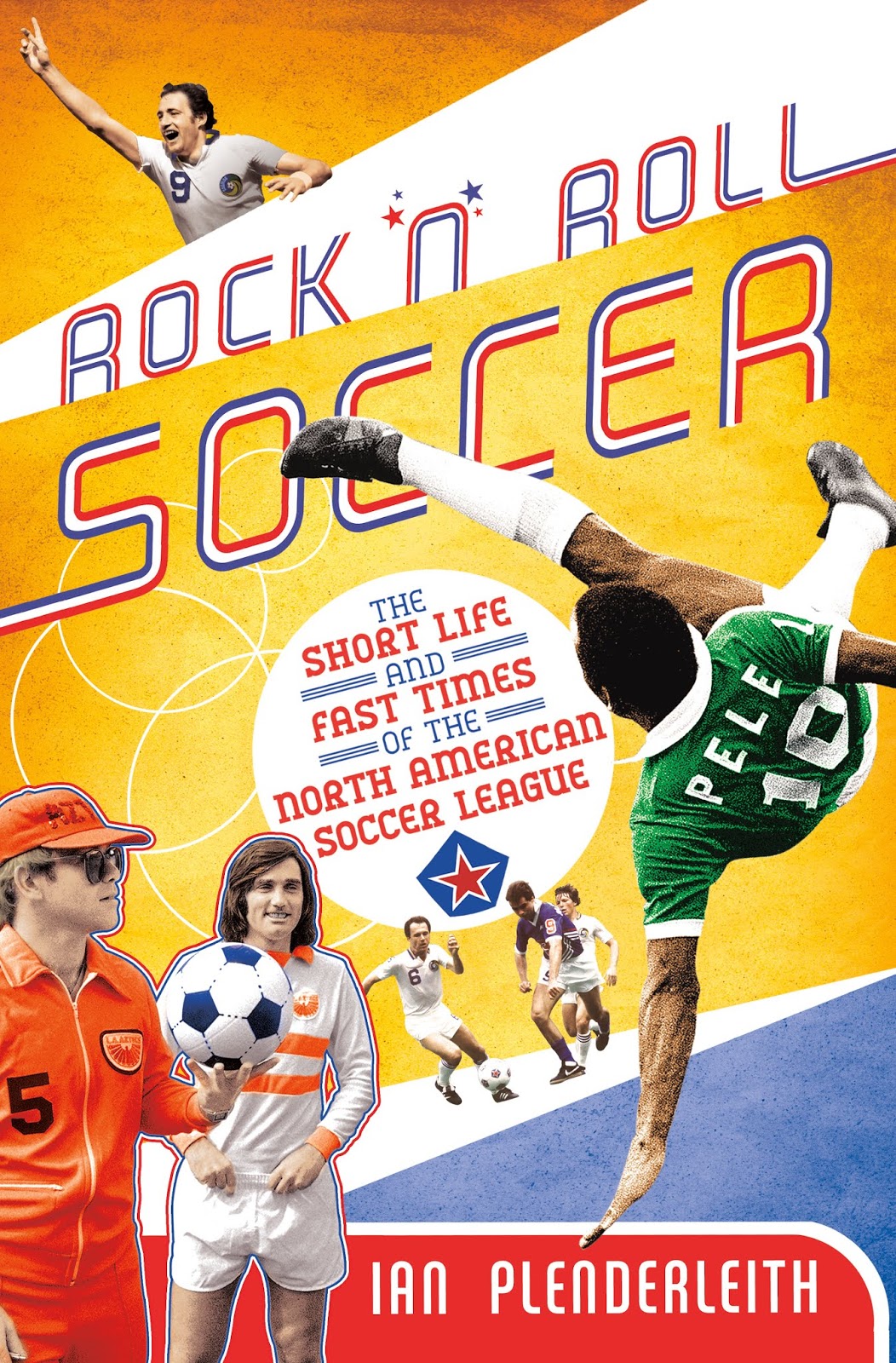
ROCK N ROLL SOCCER: The Short Life and Fast Times of the North American Soccer League, by Ian Plenderleith. This is the blog to back the book hailed as "fantastic" by Danny Kelly on
Talksport Radio, and described as a "vividly entertaining history of the league" in the Independent on Sunday. In the US, Booklist described it as "a gift to US soccer fans". The UK paperback edition published by Icon Books is now available here for just £8.99, while the North America edition published by St. Martin's Press/Thomas Dunne Books can be found here for $11.98. Thank you.
Showing posts with label Manchester City. Show all posts

Wednesday, December 12, 2018

"I love that!" When your book gets a nationwide plug, but no credit

Overstocked, undersold.
Considering the number of soccer fans in North America, sales of 'Rock n Roll Soccer' in the continent have been, frankly, more than disappointing. As a writer, you can rationalise a book's failure in order to distract yourself from a creeping insecurity about your own abilities. That is, you find someone or something else to blame besides yourself. The following reasons, I've speculated, may all be the cause of public indifference to an analysis and history of the North American Soccer League:

- a very poor publicity effort by the publisher, St. Martin's Press. "If it's not made the NY Bestsellers' List in two weeks, publishers lose interest," an insider told me. They certainly did. A planned book tour was supported in theory, but not with anything as helpful as cash or staff.

- sparse coverage from the mainstream sports media. All the major national print and broadcast outlets ignored the book - no surprise, given my lack of both fame and extensive contacts. The author's name is often way more important than the contents of their book. An old buddy from the press box? Sure, we'll mention your book! Known for spouting off shite on social media to several thousand followers? You're in!

- a lack of interest in North America's soccer history both among fans (see book sales) and teams - not a single Major League Soccer or NASL Mark 2 club was interested in or, in most cases, even had the courtesy to respond to my requests to host a reading. Even though this lack of interest was, ironically, something that the book sought to rectify. This may be down to the fragmented nature of US soccer history, or it may be due to the relentlessly forward-looking norms of a sport that still considers itself to be on the rise. 

The 50th anniversary of the NASL's kick-off this year and the rapid success of MLS new boys Atlanta United may both have been a potential peg to revive interest in the subject, but I've lost so much money on the book by now that it hasn't been worth the risk of investing more unpaid time. Still, I was intrigued to see an interview run by the Associated Press last week with the former chief executive of NASL co-founders the Atlanta Chiefs, Dick Cecil, that ran across several media. Including the Washington Post and the New York Times, both of whom ignored 'Rock n Roll Soccer'.

Around two-thirds of the way through the piece, the writer Paul Newberry mentions how the Chiefs achieved some measure of international fame in their first year by twice beating English champions Manchester City. I quote, without permission:

Cecil gleefully pulls out a book about the history of the NASL.
“Look at the title of the first chapter,” he says.
I thumb quickly to the table of contents.
“Atlanta, Champions of England,” it says.
“I love that!” Cecil says, erupting in a laugh pulled straight from the belly.

"I love that!" 
My book! But the Associated Press doesn't cite the title of the book, doesn't mention the name of the author. I continue reading to the end of the interview, feeling that I am waving goodbye to a ship that was supposed to take me off the island, but which is now steaming over the horizon without a backward glance. Is there anything left for me to eat on the island? I turn around, and there are on the beach are several piles of unsold copies of 'Rock n Roll Soccer'...

The publisher did write to me last year and offer me its "overstock" of 697 copies at a not particularly bargain price. Otherwise, their fate was unclear - pulped or remaindered? I suggested that they should be donated to the libraries of the country's state and federal prisons, which more than outnumber the overstocked books. They must still be thinking about that option, as I've yet to receive a reply.

'Rock n Roll Soccer' is still available here for $11.98. The author's latest book, 'The Quiet Fan', is available in the US here from amazon, and in the UK from When Saturday Comes magazine.

Tuesday, July 29, 2014

"Marsh has overshadowed Pelé, no doubt about it"

Tampa Bay Rowdies coach Gordon Jago said of players like Rodney Marsh that “you have to accept them the way they are. Only a fool would try to submerge those assets.” Yet the 1970s were full of fancy-footed, flair players who were adored by fans but submerged by managers and clubs who couldn’t afford to let a single unruly player look bigger than the club, no matter how special his talents. Spurned by the tactically dull English game and the post-Victorian disciplinary norms of its custodians, many of the more individualistic British players found the North American Soccer League to be a far more receptive platform for their charisma-driven style, both as a footballer and a personality.

Chapter 4 of Rock n Roll Soccer examines at length the largely successful NASL careers of Marsh and George Best, looking to resurrect their reputations after having fallen out with Manchesters City and United respectively. While both had their issues with team bosses and coaches in the USA just as they had done in Britain, the two players were also uniquely suited to bringing the NASL the kind of panache and publicity that it was craving during its heady expansion years in the mid 1970s. Here are the opening paragraphs to ‘Marsh and Best: Entertaining the USA’:

Marsh and Best: hair and flair
Rodney Marsh stopped the game, although referee Peter Johnson hadn’t blown his whistle. The Tampa Bay Rowdies midfielder fell to his knees, stretched out his arms and gestured at the ball in his possession. Come and get it, he was saying to the New York Cosmos, a team that was losing 4–0, and whose pivotal player, Pelé, was not having his greatest day. Come on, come and get it – I know you can’t, but try anyway.

It was the 1976 season, and the first visit by the Cosmos to the upstart Tampa Bay Rowdies since Pelé’s signing the previous year. The New York team, fresh off the plane from an exhibition game in the Dominican Republic, looked distinctly out of sorts, playing in front of a national TV audience and a regular-season League record crowd of over 42,000. They finished exhausted, outplayed, and soundly beaten by five goals to one. The talking point of the game was not, however, the exemplary hat-trick that Derek Smethurst put past New York’s hapless second-choice goalkeeper Kurt Kuykendall. It was Marsh, down on his knees, taunting a team that featured the greatest player of all time. 

The Englishman, playing his first NASL season, opened up and flaunted a full bag of tricks that day. There were cheeky back-heel passes, nonchalant dummies, and a flawless back-heeled lob over his own head down the left wing that saw him breeze past a floundering opponent. On another occasion he effortlessly robbed an oncoming Cosmos player of the ball, then passed it forward down the line to a teammate, all the while holding his left boot, lost in action moments before. Marsh fully exploited the vast space in midfield that the Cosmos and the 35-yard offside line (see chapter 7 for more on this NASL innovation) permitted him, prompting CBS’s co-commentator Paul Gardner to say at the end of the afternoon, ‘Marsh has overshadowed Pelé, no doubt about it.’ When he left the field shortly before the end of the game, he received a standing ovation… 

Monday, July 14, 2014

"They couldn't play in the fourth division in England"

Chapter one of Rock n Roll Soccer (‘Atlanta, Champions of England’), not only covers the difficult inception of the North American Soccer League in 1968 - the result of a merger between two rival professional leagues that had started up in 1967 - but also the extraordinarily gruelling tour of newly crowned English champions Manchester City to Canada, Mexico and the United States. In May 1968, City played one of the NASL’s more promising new teams, the Atlanta Chiefs, in a friendly game that caught the imagination of local fans. City lost 3-2, but when two subsequent games in Mexico were cancelled, they opted against an early return home in favour of returning to Atlanta to try and beat the Chiefs at the second attempt.

Extract:
Manchester City’s assistant manager Malcolm Allison didn’t take his team’s defeat to Atlanta well. Prior to the game on 27 May 1968, he had been sanguine, while the local media touted City as champions of England and thus possibly the best team in the world – a deductive leap that, in the name of publicity, few in either camp would have bothered to dispute. ‘The stadium is a beautiful facility and the pitch is fine with us,’ Allison said. ‘It won’t make a bit of difference to us play­ing on part of a baseball infield. It’ll be just like playing on a frozen field in England. And we’ve played in all kinds of condi­tions.’ He even pre-empted excuses about City struggling after a long, hard season, because it just meant ‘we really don’t need that much practice’.

The Atlanta Chiefs promote themselves in a city
parade to an unsuspecting public in 1967
(Ron Newman private collection)
His players were more cautious. Tony Book, looking back at an already demanding tour (City had so far played and drawn with Dunfermline Athletic, twice, in Toronto and New Britain, and then beaten the Rochester Lancers 4–0) conceded that ‘the team is a little tired, since we’ve had to really play in these games. It seems everyone wants to beat us.’ With City missing some key players on international duty, the game could be a close one. Should that happen, he added, ‘it could be a great thing for soccer. It would be great for the game, because everyone back home and over the world is watching soccer in America. And we all want it to succeed here.’

Book’s comments reflect that City, to their huge credit, willingly co-operated in selling the exhibition game to the Atlanta public, arriving in the city a few days in advance, show­ing up at various banquets and receptions in their honour, and generally doing their part to talk up the coming game and soccer in general. In spite of the rigours of a demanding tour at the end of a long and extremely successful English season, manager Joe Mercer at least gave the impression that his side was taking it all seriously enough. ‘Although we don’t quite know what to expect, you can bet we won’t be complacent,’ he said. ‘I haven’t seen the Chiefs play, but I do know some of their players and what their capabilities are.’ Francis Lee also cautioned that ‘they just might give us a pleasant, or unpleas­ant, surprise.’

Pleasantly, or unpleasantly, City lost 3–2 in front of 23,000 raucous fans, and Allison’s reaction was far from gracious. ‘They couldn’t play in the Fourth Division in England,’ he said. ‘The boy that kicked the last goal was offside too. They played well. We played poorly. It’s as simple as that. It hap­pens sometimes in England. The Third and Fourth Division sides come up and beat the First and Second Division teams. They just want the game more. The Chiefs had more to gain tonight than we did. We played like we didn’t really want to win the match.’