News and reviews of Rock n Roll Soccer


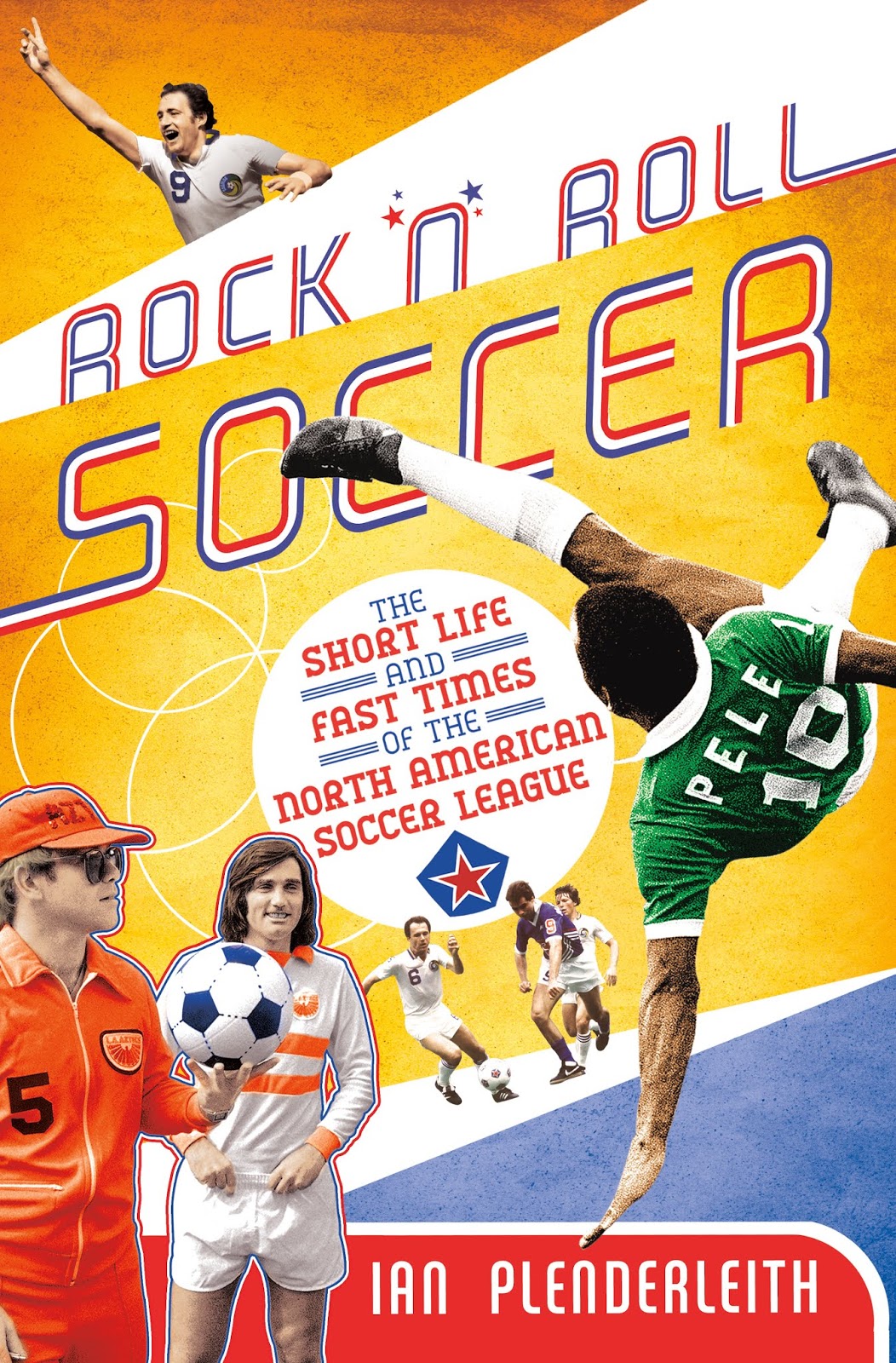
ROCK N ROLL SOCCER: The Short Life and Fast Times of the North American Soccer League, by Ian Plenderleith. This is the blog to back the book hailed as "fantastic" by Danny Kelly on
Talksport Radio, and described as a "vividly entertaining history of the league" in the Independent on Sunday. In the US, Booklist described it as "a gift to US soccer fans". The UK paperback edition published by Icon Books is now available here for just £8.99, while the North America edition published by St. Martin's Press/Thomas Dunne Books can be found here for $11.98. Thank you.
Showing posts with label Major League Soccer. Show all posts

Wednesday, December 12, 2018

"I love that!" When your book gets a nationwide plug, but no credit

Overstocked, undersold.
Considering the number of soccer fans in North America, sales of 'Rock n Roll Soccer' in the continent have been, frankly, more than disappointing. As a writer, you can rationalise a book's failure in order to distract yourself from a creeping insecurity about your own abilities. That is, you find someone or something else to blame besides yourself. The following reasons, I've speculated, may all be the cause of public indifference to an analysis and history of the North American Soccer League:

- a very poor publicity effort by the publisher, St. Martin's Press. "If it's not made the NY Bestsellers' List in two weeks, publishers lose interest," an insider told me. They certainly did. A planned book tour was supported in theory, but not with anything as helpful as cash or staff.

- sparse coverage from the mainstream sports media. All the major national print and broadcast outlets ignored the book - no surprise, given my lack of both fame and extensive contacts. The author's name is often way more important than the contents of their book. An old buddy from the press box? Sure, we'll mention your book! Known for spouting off shite on social media to several thousand followers? You're in!

- a lack of interest in North America's soccer history both among fans (see book sales) and teams - not a single Major League Soccer or NASL Mark 2 club was interested in or, in most cases, even had the courtesy to respond to my requests to host a reading. Even though this lack of interest was, ironically, something that the book sought to rectify. This may be down to the fragmented nature of US soccer history, or it may be due to the relentlessly forward-looking norms of a sport that still considers itself to be on the rise. 

The 50th anniversary of the NASL's kick-off this year and the rapid success of MLS new boys Atlanta United may both have been a potential peg to revive interest in the subject, but I've lost so much money on the book by now that it hasn't been worth the risk of investing more unpaid time. Still, I was intrigued to see an interview run by the Associated Press last week with the former chief executive of NASL co-founders the Atlanta Chiefs, Dick Cecil, that ran across several media. Including the Washington Post and the New York Times, both of whom ignored 'Rock n Roll Soccer'.

Around two-thirds of the way through the piece, the writer Paul Newberry mentions how the Chiefs achieved some measure of international fame in their first year by twice beating English champions Manchester City. I quote, without permission:

Cecil gleefully pulls out a book about the history of the NASL.
“Look at the title of the first chapter,” he says.
I thumb quickly to the table of contents.
“Atlanta, Champions of England,” it says.
“I love that!” Cecil says, erupting in a laugh pulled straight from the belly.

"I love that!" 
My book! But the Associated Press doesn't cite the title of the book, doesn't mention the name of the author. I continue reading to the end of the interview, feeling that I am waving goodbye to a ship that was supposed to take me off the island, but which is now steaming over the horizon without a backward glance. Is there anything left for me to eat on the island? I turn around, and there are on the beach are several piles of unsold copies of 'Rock n Roll Soccer'...

The publisher did write to me last year and offer me its "overstock" of 697 copies at a not particularly bargain price. Otherwise, their fate was unclear - pulped or remaindered? I suggested that they should be donated to the libraries of the country's state and federal prisons, which more than outnumber the overstocked books. They must still be thinking about that option, as I've yet to receive a reply.

'Rock n Roll Soccer' is still available here for $11.98. The author's latest book, 'The Quiet Fan', is available in the US here from amazon, and in the UK from When Saturday Comes magazine.

Tuesday, December 8, 2015

Major League Soccer’s Existential Dilemma

Personality x 3: Chinaglia, Pelé, Beckenbauer
Wendy Parker's review of Rock n Roll Soccer at Sports Biblio last week highlighted the book's conclusion, where I write about the lack of personality in Major League Soccer compared with its fore-runner, the North American Soccer League. That's an aspect of the book that's been further thrown into focus this week as MLS concluded another season with yet another new champion, the Portland Timbers. All for the good, of course. Who doesn't like to see titles shared around? Who wants to be like Europe, where Barcelona or Bayern Munich win year after year?

On the other hand, there's a major existential problem here for MLS. Commissioner Don Garber is never slow to talk about where his league stands in comparison with its European counterparts. He likes to set vague future goals about when MLS will be big, bigger and biggest. Last week he was talking up the rotating championship title as a reflection of "one of the most competitive leagues in the world". Yet when we think about MLS, what are the equivalent keywords to the NASL's feverishly listed Cosmos, Pelé, Beckenbauer, Best, Cruyff, Chinaglia? You can't answer back with 'parity' and expect to hold anyone's interest. 

But didn't MLS sign David Beckham? Wasn't that the league's Pelé moment? Beckham may be a polite and wealthy young man, but his on-field and off-field personality fell way short of making an impact the size of Pelé's. His former team, the LA Galaxy, may be five-times record champion, but they don't yet have the stature or the style - in any respect - to be seen as the North American domestic giants. They just happen to be the team that has won MLS Cup more than anyone else, without offering many thrills on the way. They also boasted the league's and the United States' best ever player, Landon Donovan, but he needed to be one of many. Instead, he was just one of one. Now he's retired, leaving Toronto's Italian striker Sebastian Giovinco as the league's sole outstanding player in 2015.

In late October, I managed to get a ticket for Eintracht Frankfurt's home game with Bayern Munich. It's the only guaranteed sold out home game for Eintracht, and it's been that way for decades. Every right-thinking German soccer fan hates Bayern, and wants to see them defeated. Though in fact you could leave the word 'defeated' out of the previous sentence. Even as we despise them, we are fascinated at the way they can tear opponents apart with audacious attacking soccer. On the night, Frankfurt defended their asses off and grabbed a point in a 0-0 draw - the first points that Bayern had dropped all season. It's been a point of some pride in a mainly dire season for Frankfurt.

Bayern Munich - hated, but talked about. Rich, hugely successful, and inversely popular. They are a globally massive team. Am I really saying that MLS needs a team like Bayern to win MLS Cup year after year? Not at all. MLS could, however, urgently use four or five teams with some measure of Munich's magnetism. At the moment, parity means 20 clubs that vary from anaemic to presentable. There are still too many MLS games when the teams seem to think that the idea of soccer is to keep the ball as far away from both goals as possible. Importing veteran star names like Andrea Pirlo, Kaka, Steven Gerrard and Frank Lampard is a sign of stagnant imaginations in the league's front offices. These players won't make the league any worse, but neither they will they do much for its future. Eventually expanding the number of teams to 28, as MLS announced just this week, is making me feel tired as I type, and it's only nine in the morning. 
Fatal expansion: Former NASL commissioner
 Phil Woosnam presents quantity over quality. 


Garber pointed out last week that "we’re spending almost $120 million on DPs [Designated Players]. That’s six times what we spent five years ago. So if we’re able to grow our business, our owners are going to spend more money. And it’s not just going to be on our core roster. It’s going to be on areas where we can spend more on players that will improve quality." To paraphrase the commissioner - spending money on big name players means the league will attract even more money, and then we can invest that in long term youth development. That's a leap of faith that's hard to quantify, even with the aid of corporate flow charts. As a Plan for the Future, it's lacking exactly what you would hope for in a plan for the future - a clear-sighted vision, and a cogent means of getting there.

In the book's conclusion I generally show understanding for the MLS approach to building a league during those nascent years. Its caution, its prudence, and its need to develop in a way that will not frighten off new investors with concepts like relegation and bankruptcy. Yet, as that $120m figure above shows, parity and the salary cap have become fluid concepts according to the league's evolving needs. 

That salary cap isn't fooling anybody, and is increasingly meaningless when the league, with a ludicrous and shameless lack of transparency, will not even reveal its teams' profits and losses, transfer figures, or salaries (we have to rely on leaks, Forbes and the players' union for any of this information). What remains of parity's sham are the shackles preventing the emergence of teams with the kind of power and personality that - compared with the old NASL - is conspicuously missing. Still in place is a league more focused on its balance sheet than its league table and the quality of its play.

A possible solution? MLS should stop trying so hard to control its own history. Quit setting grandiose goals, drop the business-speak, and cease caring about how it shapes up compared with Spain, England and Germany. Retire Garber - he's steered the league to security, but his job is done. Bring in someone (former deputy Ivan Gazidis?) who has a genuine feel for the game. Remove parity and let the clubs chart the league's history, mistakes and all. Allow supporters to develop a team's culture, not the marketing department.

It wouldn't mean having to see the same team celebrate lifting the championship trophy year after year. The playoffs will prevent the dominant teams from serially winning titles and always give outsiders a chance. Even the mighty Cosmos only won four of the ten NASL titles between 1975 and 1984. They had charisma, but it was infectious. And as that league discovered too late - better a smaller, vibrant league than ill-conceived expansion for expansion's sake.