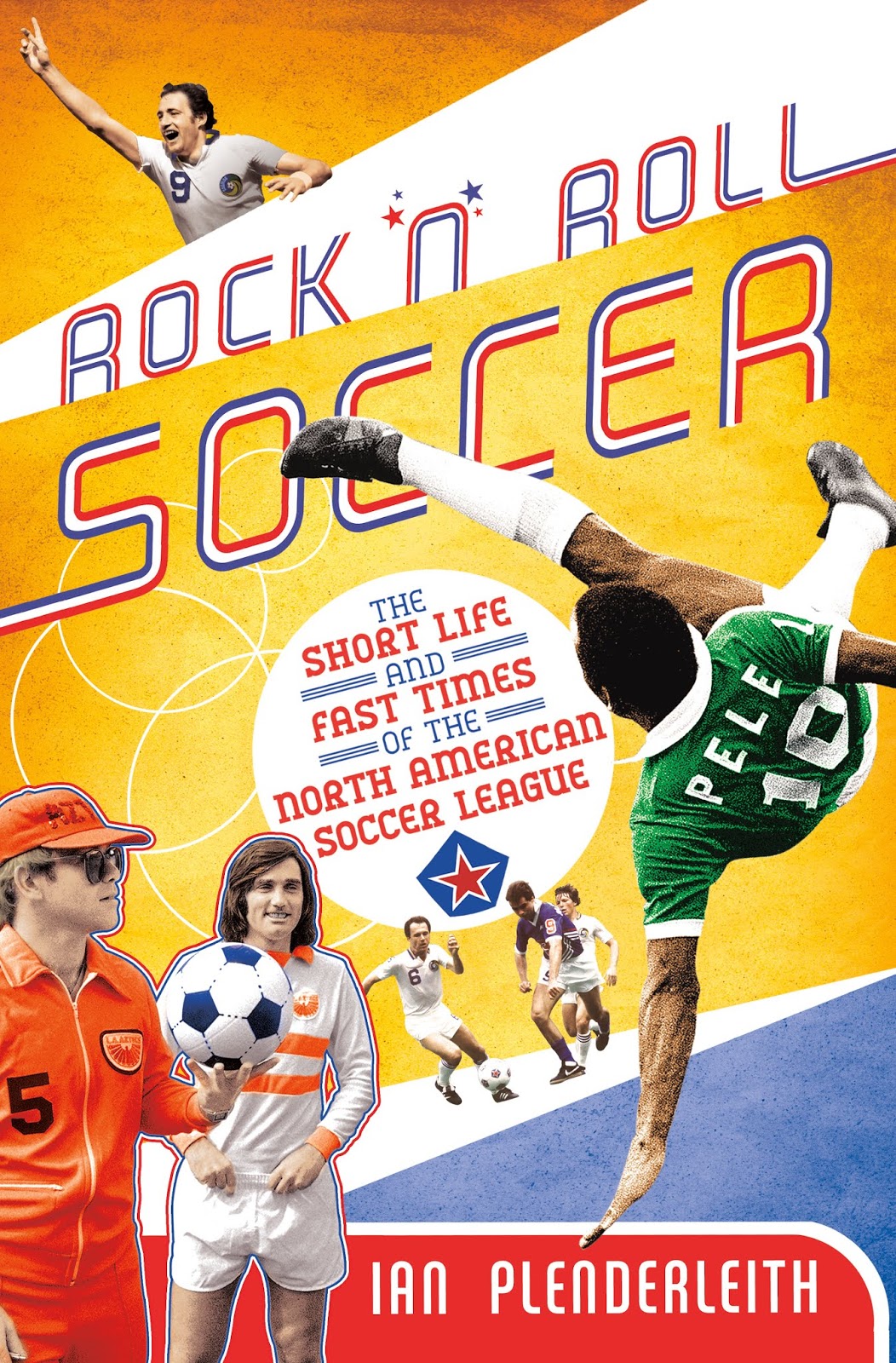
News and reviews of Rock n Roll Soccer


ROCK N ROLL SOCCER: The Short Life and Fast Times of the North American Soccer League, by Ian Plenderleith. This is the blog to back the book hailed as "fantastic" by Danny Kelly on
Talksport Radio, and described as a "vividly entertaining history of the league" in the Independent on Sunday. In the US, Booklist described it as "a gift to US soccer fans". The UK paperback edition published by Icon Books is now available here for just £8.99, while the North America edition published by St. Martin's Press/Thomas Dunne Books can be found here for $11.98. Thank you.
Showing posts with label Dick Cecil. Show all posts

Wednesday, December 12, 2018

"I love that!" When your book gets a nationwide plug, but no credit

Overstocked, undersold.
Considering the number of soccer fans in North America, sales of 'Rock n Roll Soccer' in the continent have been, frankly, more than disappointing. As a writer, you can rationalise a book's failure in order to distract yourself from a creeping insecurity about your own abilities. That is, you find someone or something else to blame besides yourself. The following reasons, I've speculated, may all be the cause of public indifference to an analysis and history of the North American Soccer League:

- a very poor publicity effort by the publisher, St. Martin's Press. "If it's not made the NY Bestsellers' List in two weeks, publishers lose interest," an insider told me. They certainly did. A planned book tour was supported in theory, but not with anything as helpful as cash or staff.

- sparse coverage from the mainstream sports media. All the major national print and broadcast outlets ignored the book - no surprise, given my lack of both fame and extensive contacts. The author's name is often way more important than the contents of their book. An old buddy from the press box? Sure, we'll mention your book! Known for spouting off shite on social media to several thousand followers? You're in!

- a lack of interest in North America's soccer history both among fans (see book sales) and teams - not a single Major League Soccer or NASL Mark 2 club was interested in or, in most cases, even had the courtesy to respond to my requests to host a reading. Even though this lack of interest was, ironically, something that the book sought to rectify. This may be down to the fragmented nature of US soccer history, or it may be due to the relentlessly forward-looking norms of a sport that still considers itself to be on the rise. 

The 50th anniversary of the NASL's kick-off this year and the rapid success of MLS new boys Atlanta United may both have been a potential peg to revive interest in the subject, but I've lost so much money on the book by now that it hasn't been worth the risk of investing more unpaid time. Still, I was intrigued to see an interview run by the Associated Press last week with the former chief executive of NASL co-founders the Atlanta Chiefs, Dick Cecil, that ran across several media. Including the Washington Post and the New York Times, both of whom ignored 'Rock n Roll Soccer'.

Around two-thirds of the way through the piece, the writer Paul Newberry mentions how the Chiefs achieved some measure of international fame in their first year by twice beating English champions Manchester City. I quote, without permission:

Cecil gleefully pulls out a book about the history of the NASL.
“Look at the title of the first chapter,” he says.
I thumb quickly to the table of contents.
“Atlanta, Champions of England,” it says.
“I love that!” Cecil says, erupting in a laugh pulled straight from the belly.

"I love that!" 
My book! But the Associated Press doesn't cite the title of the book, doesn't mention the name of the author. I continue reading to the end of the interview, feeling that I am waving goodbye to a ship that was supposed to take me off the island, but which is now steaming over the horizon without a backward glance. Is there anything left for me to eat on the island? I turn around, and there are on the beach are several piles of unsold copies of 'Rock n Roll Soccer'...

The publisher did write to me last year and offer me its "overstock" of 697 copies at a not particularly bargain price. Otherwise, their fate was unclear - pulped or remaindered? I suggested that they should be donated to the libraries of the country's state and federal prisons, which more than outnumber the overstocked books. They must still be thinking about that option, as I've yet to receive a reply.

'Rock n Roll Soccer' is still available here for $11.98. The author's latest book, 'The Quiet Fan', is available in the US here from amazon, and in the UK from When Saturday Comes magazine.

Wednesday, August 29, 2018

Ron Newman: 1936-2018. "When the NASL folded I was sitting in my office crying my eyes out"

I was saddened to hear of the death on Monday of former North American Soccer League player and coach, Ron Newman. Five years ago this week I talked to Ron, who granted me an extensive and entertaining interview about his time in the NASL. Many extracts from that interview ended up in Rock n Roll Soccer (he has 12 referrals in the book's index), but much of it has remained on my hard drive.

In tribute to a kind and generous man who gave so much to the game in the US, here is the interview in full:

What brought you to the USA and the Atlanta Chiefs in 1967?

Ron Newman: I was sold by Portsmouth to Orient and through the club I took over this house where [future NASL Commissioner] Phil Woosnam had been living while he was at West Ham. I used to get his post and send it on to him, though I didn’t know him. We got talking one time in the players’ tunnel and had quite a long chat. Now when I was in the army I was a drill instructor, so I knew how to handle people, and when my career started to wind down I thought I wouldn’t mind a go at coaching. Eddie Firmani was talking to me about coaching abroad in Australia or South Africa. But then I got a call from Phil and he said, ‘Don’t go to South Africa, come with me to America.’ I said, ‘America? They can’t play the bloody game over there!’But I talked about it with the kids and we ended up going, all because of that link up with the house where we’d both lived.

What was it like that first year in Atlanta?

Newman: Everything was new. Everything was huge. Right in the beginning I’d met the people from Atlanta in a hotel in London, and we had lobster. I’d never had lobster before, we couldn’t afford that. This of course was the baseball people. My son, who was about eight, had just started playing soccer and he didn’t want to go because there was no soccer in Atlanta. We told him they had hamburgers and colour television over there, so that persuaded him. When I got to Atlanta I told him we were

Tuesday, August 19, 2014

"I didn't know who the hell FIFA was and I didn't care"

The North American Soccer League’s relationship with FIFA was fractious from the go, and it barely progressed to the point of cordiality in the next two decades. NASL Commissioner Phil Woosnam was forever lobbying to innovate at the behest of owners such as the Atlanta Chiefs chief executive Dick Cecil who initially, in his own words, “didn’t know who the hell FIFA was and I didn’t care”. The NASL meddled with the points system, the offside law, shirt numbers, and the number of permitted substitutions, and it became wholly opposed to the idea of ending any game in a draw. The NASL knew that to sell the sport to a new market, it had to understand what it was that the fans – unencumbered by 100 years of history and tradition – wanted from 90 minutes of sporting entertainment.
Sport imitating art: Subbuteo-style, the NASL
 experimented with a 35-yard line to spread
 play and decrease offside calls.


Not all of its ideas worked, or were necessarily beneficial to the game as a spectacle, but at least this was a league prepared to instigate a discussion and then take action at a time when FIFA took (and still takes) years to even contemplate the possibility of change. And it happened in a decade, the 1970s, when football was at its nadir of negativity in terms of tactics and goalscoring. In this excerpt from Chapter 7, The NASL vs FIFA and the world, we look at the changes that the NASL, with FIFA’s eventual (but reluctant) approval, made to the field of play. By adding a 35-yard offside line (think Subbuteo), the league attempted to stretch the play, minimize offside, and avoid the tight and frenzied midfield stalemates so prevalent in Europe at the time:

One of the rumours that did the rounds in the 70s was that ‘the Yanks want to abolish the offside law’. This was another supposed example of how the Americans wanted to mutilate and destroy our game, and although it was mooted by a couple of teams at the League’s inception, it was voted down by those who had a vague clue about soccer and its place in the world. However, anyone who recalls the offside trap of the 1970s and 1980s in European soccer might grant the idea of even discussing a change to the offside law a little sympathy. For the benefit of those who weren’t there, or who have shut out the memory, lines of defenders would step forward at the apposite moment with their arms simultaneously raised in appeal, usually catching an opponent clear through on goal, but yards offside. This could happen time and time again, and would prompt much agonizing among television pundits about what to do. The answer, as always from the European game, was nothing. On the other hand, it was of course a wonderful sight when one or more of the defenders got his timing wrong, the linesman kept his flag down, and all of a sudden the forward was through on goal with only the keeper to beat. If the forward scored, the defenders would jaw at the linesman as if he had personally advised them to step up like line dancers and ignore the ball in favour of a negative, under- handed tactic which had never been envisioned when a more Corinthian generation had devised the law as a way of avoiding goal-hangers.

For the unique case of the NASL, though, a modification was in order. In the middle of the 1972 season FIFA allowed the NASL to experiment with an offside line in line with the penalty area, but it was a fiasco – defenders played so deep that play became entrenched in the penalty area and goals per game actually decreased. It was brought upfield to become a 35-yard line for the 1973 season. Long-serving NASL coach Ron Newman explains that one of the reasons the offside line was introduced ‘was mainly down to the fact that we kept playing in high school arenas and they were so long and narrow. You were fitting a soccer field inside a running track, and it was hard in this country, because the running track was a different shape here – more narrow, and you’d get things like a long jump pit down the edge of the field and you had to cover it up.’ With the game already constricted by narrow pitches, having the offside line on halfway squeezed play still further. Despite its introduction being designed to fit the unique case of US soccer, Newman believes ‘without question’ that a 35-yard offside line would have worked for the rest of the world.

Phil Woosnam explained the rationale when FIFA, after a year of deliberation, finally gave the League the go-ahead to try the experiment. ‘By opening up the play with this change in the offside law, we feel that spectators will be treated to a more exciting and enjoyable brand of soccer,’ he said. ‘The entire world of soccer recognizes that changes in the laws that produce greater goal-scoring opportunities must be considered. It is our belief, shared by many European officials, that the ultimate answer is to make a change in the offside rule and the size of the goal.’ Some years later, he explained to Observer journalist Hugh McIlvanney another reason for the offside line: ‘An increasing influence of coaches and players from England in North America was resulting in an increase in the use of offside tactics, congestion of players in midfield and tight marking of skilful players by extremely physical defenders.’